
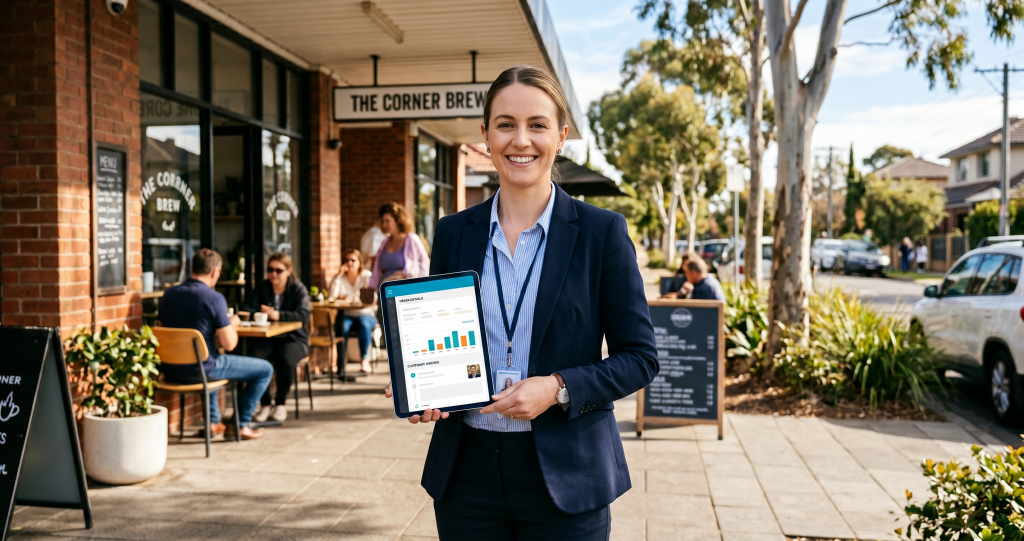
If you’re a sales manager at an Australian food distribution business, you know the feeling: your reps are out on the road, your phone is ringing, and you genuinely don’t know what’s happening until someone sends a WhatsApp at 4pm. Field sales management in Australia has always been tough, high-volume, time-sensitive, and built on personal relationships that took years to build.
Field sales management Australia is at a turning point. The tools that worked five years ago like spreadsheets, printed call sheets, gut feel aren’t keeping up. This post covers exactly how distributors in the food and FMCG space are adapting: what’s changed, what the best teams are actually doing, and what software is making the biggest difference.
If you want to see how mSalesApp handles this for Australian distributors, request a demo.
What’s changed in Australian food distribution field management in 2026?
The industry has shifted significantly since COVID tighter margins, harder-to-find staff, and customers who expect faster turnaround on orders have combined to make “winging it” in field sales no longer viable for most distributors.
The numbers tell the story. Australia’s general line grocery wholesaling industry is projected to reach $32 billion in revenue in 2025–26, according to IBISWorld; a market that’s still growing despite headwinds from retailers bypassing traditional distribution channels. Meanwhile, Australia’s food logistics sector reached USD $2.4 billion in 2024 and is forecast to hit USD $4.3 billion by 2033, reflecting a CAGR of 6.35% (IMARC Group, 2024).
According to the Australian Bureau of Statistics, wholesale trade employment grew by approximately 9,000 people (1.5%) in 2023–24, with wages rising 5.7% meaning distributors are paying more for talent and need to get more productivity out of every rep on the road.
Three things have fundamentally changed how Australian food distributors think about managing field reps:
- Post-COVID route disruption. Many reps rebuilt their call routes from scratch after 2020–21 lockdowns. The old rhythms are gone, and what’s replaced them is messier and harder to manage without proper tooling.
- Customer expectations around ordering speed. Buyers at cafés, restaurants, and independent retailers now expect to place or confirm orders faster. Waiting for a rep to phone in an order at end of day isn’t good enough anymore.
- Staff shortages driving efficiency pressure. When you lose one experienced rep and replace them with someone new, the knowledge transfer gap is brutal without a proper system.
The distributors who are managing this well have moved to mobile-first field sales force automation workflows. The ones still relying on spreadsheets and calls are feeling the squeeze.
How do Australian food distributors track field reps in real time?
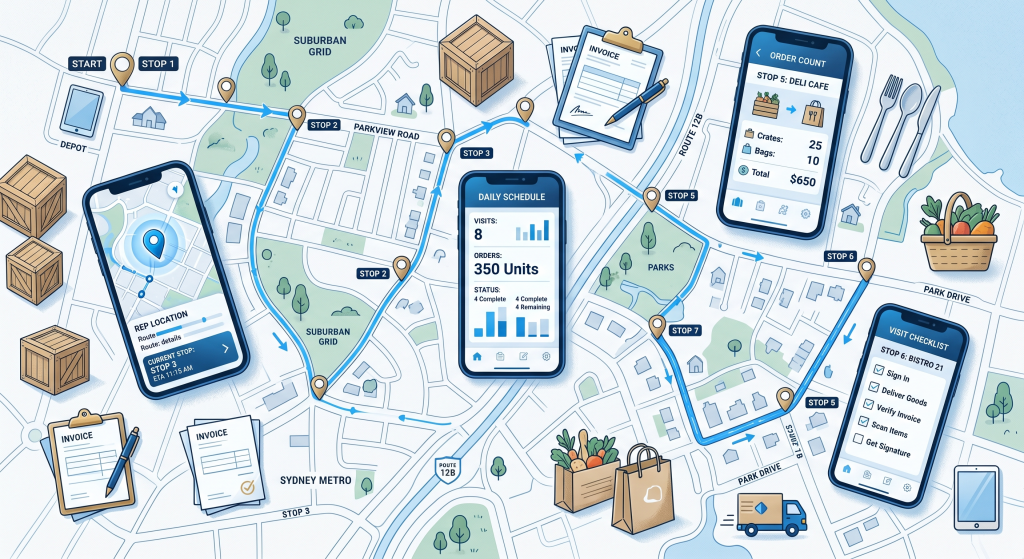
Most Australian food distributors today use one of three approaches to manage field rep activity and only one of them actually gives managers the real-time visibility they need without a significant IT overhead.
The old way: spreadsheets and phone calls
Still more common than you’d think. A rep gets a printed or emailed call list, works through it during the day, and reports back at end of day (or doesn’t). The manager has no idea what happened until they chase it up. It’s low cost on paper but the time lost to chasing, re-keying data, and dealing with order errors adds up fast.
Generic CRM platforms
Tools like Salesforce were built for inside sales and enterprise account management. They’re not designed for a rep standing in a café kitchen trying to take an order on their phone in three minutes flat. Setup is complex, the mobile experience is often clunky, and integrating with Australian accounting systems like Xero or MYOB typically requires a custom project and ongoing maintenance.
Purpose-built mobile SFA apps
This is where the market has moved for serious food distribution operations. Apps built specifically for Australian food distributor field reps — like mSalesApp — are designed around the actual workflow: show up, check the customer’s order history, take the order by barcode or product list, apply any current promotions, and sync to the accounting system in real time or when connectivity returns.
How the three approaches stack up:
| Approach | Real-time visibility | Offline capable | Accounting integration | Cost |
| Spreadsheets + phone calls | ✗ | ✓ | Manual only | Low (but costly in time) |
| Generic CRM (e.g. Salesforce) | Partial | Limited | Complex setup | High |
| Purpose-built SFA (mSalesApp) | ✓ | ✓ | Native (Xero, MYOB, QuickBooks) | $299/month* |
The tradeoffs are real. Spreadsheets are cheap until you factor in the manager hours spent chasing reps, the order errors, and the accounts quietly going cold because no one noticed the visit frequency dropped. Generic CRMs are capable but expensive to set up correctly for field sales. Purpose-built sales rep management software Australia gives you the right fit from day one.
What features do Australian food distributors actually need in a field rep tool?
The features that matter most aren’t the flashy ones they’re the ones that remove friction for a rep who needs to visit 15 customers in a day and get home for dinner.
- Fast order taking with barcode scan. A rep should be able to pull up a customer, scan product barcodes or scroll a product list, and confirm an order in under three minutes. Anything slower and reps start cutting corners.
- Full customer history at a glance. Before walking in the door, a rep needs to know what was ordered last time, whether there’s an outstanding invoice, and whether there’s a promotion the customer hasn’t taken advantage of.
- Offline mode that actually works. Not all customer locations have reliable mobile coverage, cold stores, warehouses, regional accounts. A mobile SFA app that stops working without internet is a liability. mSalesApp is built offline-first: everything works without a connection and syncs when signal returns.
- Promotions engine. Managing promotional pricing in food distribution is complicated; case deals, product bundle promos, customer-specific pricing, time-limited offers. An app that handles this automatically saves significant time and prevents reps from over- or under-discounting.
- Route planning and visit scheduling. Real-time rep tracking and structured call routes help managers understand whether their team is working efficiently and help reps plan their day without backtracking across town.
- Native Xero integration (and MYOB, QuickBooks). Orders placed in the field should flow directly into the accounting system; no re-keying, no manual export.
Beyond the rep-facing features, managers also benefit from the mOrder App; a B2B customer ordering portal that lets buyers place their own orders between rep visits, at AU$0.90 per order.
How are AI and automation changing field sales management in 2026?
AI is beginning to make a real difference in field sales not by replacing reps, but by giving them better information before they walk into a customer site and flagging issues that would otherwise go unnoticed.
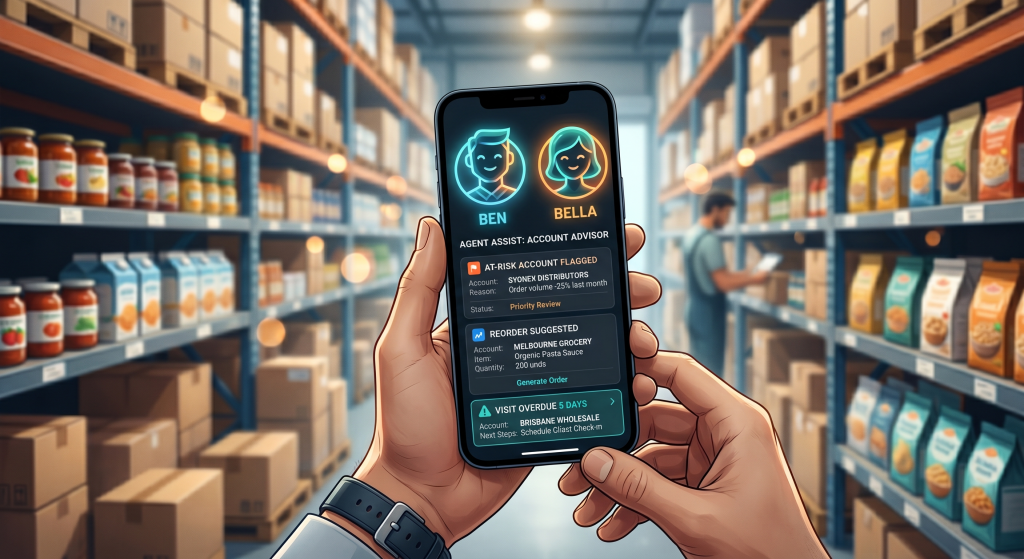
mSalesApp’s Ben & Bella AI agents won the FSAA National Innovation Award in 2023, which recognised their practical application of AI to real field sales challenges. These aren’t chatbots, they’re agents that work in the background of the app to surface useful insights: which accounts haven’t placed an order in longer than usual, which customers are strong candidates for an upsell, and which reps may need support based on their call completion data.
Where human judgment still wins relationship nuance, handling a difficult conversation with a long-term account, reading a room. AI surfaces the intelligence. The rep still does the work.
The honest picture in 2026 is that AI in mobile SFA is genuinely useful but still maturing. The distributors getting the most value from it are the ones who’ve first got the basics right clean data, consistent rep activity, proper system adoption. AI built on messy data just produces messy suggestions faster.
What do Australian food distributors say about switching to mobile SFA?
The most useful test of any field sales tool is what happens to the numbers after teams actually use it, not what the vendor promises in a demo.
“mSalesApp has helped our team increase their call completion rate by 30% and has increased daily sales by 16%.”
— Shamal Lalindra, Mentos Australia
That’s not a marginal improvement; a 30% lift in call completion means reps are visiting significantly more customers per day. At scale across a field team, that directly compounds into revenue.
“The promotions engine is where mSalesApp hands down stands out from any other mobile sales software I’ve seen. It covers all the scenarios we can think of with any promo deals.”
— Luke Muscat, Founder, Muscatech
FAQ: Frequently asked questions about managing field reps in Australian food distribution
What is field sales force automation software?
Field sales force automation (SFA) software is a mobile app designed to help field reps manage customer visits, take orders, track promotions, and sync data back to head office, all from their phone or tablet. For food distributors, it replaces spreadsheets and phone-based order taking with a structured, real-time workflow that gives managers visibility into what’s happening in the field.
How much does field rep management software cost in Australia?
Purpose-built field rep management software in Australia typically ranges from AU$150 to AU$500+ per month depending on features and team size. mSalesApp is priced at AU$299/month (or AU$2,189/year) and includes all features with no per-user limits, so the cost doesn’t scale as your team grows. Enterprise pricing is available for larger operations.
Can field reps use a sales app without internet?
Yes, a good mobile SFA app should work fully offline. mSalesApp is built offline-first: reps can take orders, access customer history, apply promotions, and complete visits without a mobile connection. Everything syncs automatically when connectivity returns. This matters in food distribution where reps often work in cold stores, basements, or regional areas with patchy coverage.
Does mSalesApp integrate with Xero, MYOB and QuickBooks?
Yes. mSalesApp integrates natively with Xero, MYOB, and QuickBooks, no middleware or custom development required. Orders placed in the field flow directly into your accounting system, keeping invoicing, inventory, and customer accounts in sync without manual re-entry.
How long does it take to set up a mobile SFA app for a food distribution team?
Most mSalesApp customers are up and running within a few weeks. The setup process involves connecting your accounting system, importing your product catalogue and customer list, and onboarding your rep team to the app. The Peercore team handles the integration side, you don’t need an IT team to get it working.
Ready to see this in action?
Field sales management Australia in 2026 is a different game to what it was five years ago. The distributors pulling ahead are the ones who’ve given their reps the right tools: mobile, offline-capable, connected to their accounting system, and smart enough to surface the things that matter.
If you’re running a food distribution team and you’re still relying on spreadsheets, WhatsApp, or a CRM that wasn’t built for field sales, the gap is widening. mSalesApp is used by Australian food and FMCG distribution teams who need something that works the way their reps actually work.
Call us on 1300 MSALES | Request a demo at msalesapp.com
